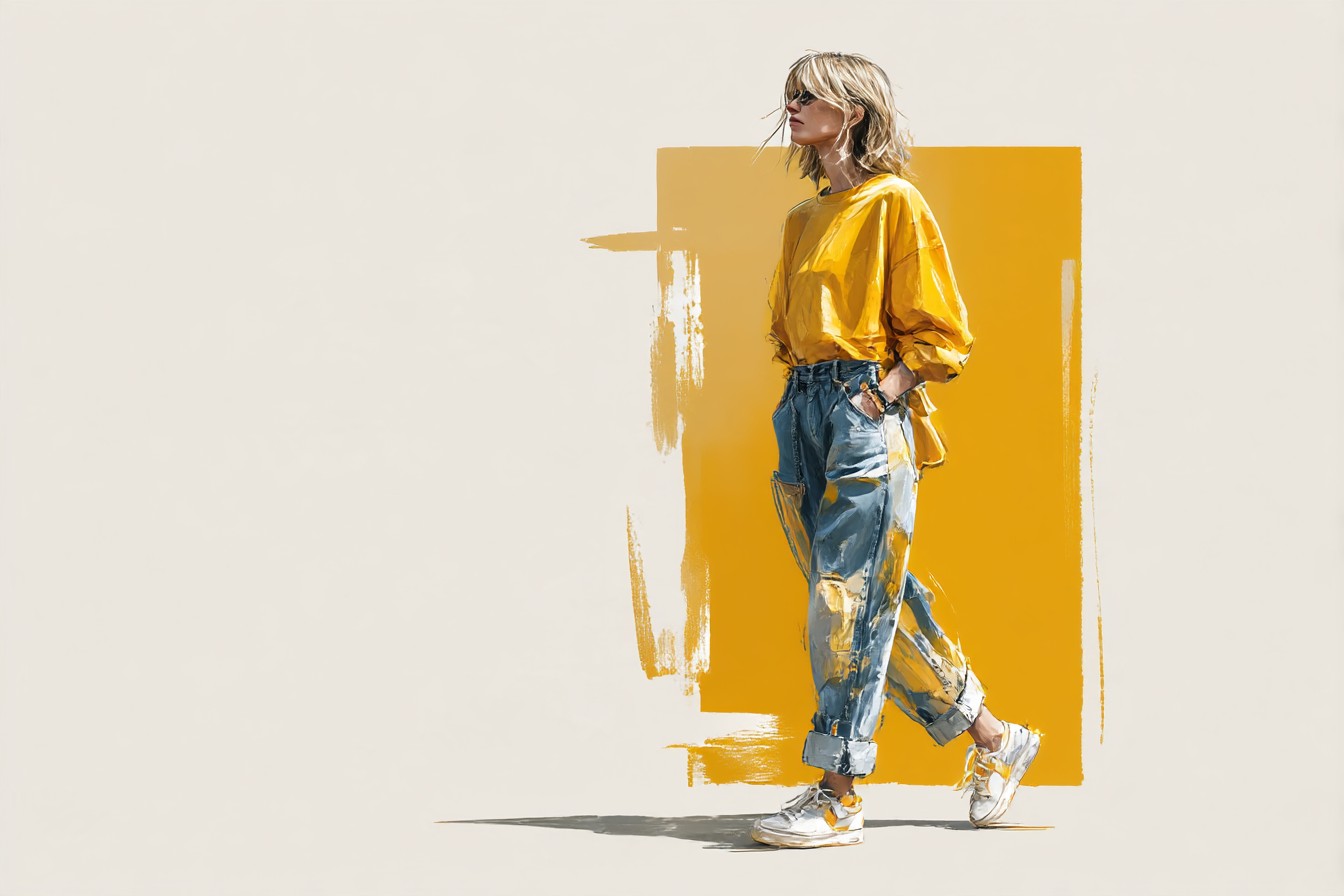
I own eleven pairs of baggy jeans. Eleven. I counted them properly last weekend while doing laundry, laying them out across the bed like some kind of denim crime scene, and I just stood there for a minute doing the math on how a person ends up here. Two are technically the same jean in different washes because I convinced myself the store had discontinued my favorite one and panic bought a backup, only to find the original still in stock three weeks later. One pair I bought specifically for a wedding because I decided, at 34, that I was too old to wear anything fitted below the waist ever again. Three came from a single reckless afternoon at a denim sale that I still cannot fully account for.

The rest just accumulated the way certain items do once you cross some invisible threshold where you stop asking “do I need this” and start asking “which era of baggy is this.”
Here is the thing nobody warns you about when you fall for the baggy jean the way I did. The jeans themselves are the easy part. You can buy a great pair of wide, slouchy, stacking-at-the-ankle denim in about fifteen minutes if you know your brand. What takes actual thought, what I genuinely got wrong for the better part of a year, is everything you put with them. Baggy jeans have a way of swallowing an outfit whole if you are not paying attention. I learned this the hard way at a friend’s birthday dinner wearing a boxy oversized sweater over a wide leg jean and flat sandals, and my friend Marisol took one look at me in the restaurant bathroom mirror and said, not unkindly, “You look like you’re wearing a sleeping bag from the waist up and a tent from the waist down.” She wasn’t wrong. I had zero shape anywhere on my body. I looked like laundry that had opinions.
That comment sent me down a real rabbit hole of figuring out what actually works, which shoes give baggy denim a reason to exist, which tops stop the whole look from reading as shapeless, and how much the specific cut and wash of the jean changes every decision that follows it. This is what I have landed on after a lot of trial, several genuine errors, and eleven pairs of jeans to show for it.
[Baggy Jeans]
Fitted Tanks and Bodysuits
The single fastest fix for the sleeping bag problem is putting something fitted on top, and I mean actually fitted, not “relaxed but not that relaxed.” A close ribbed tank or a bodysuit tucked into a high or mid rise baggy jean does something almost architectural to the silhouette. It gives your torso a defined line so the eye has somewhere to land before it hits all that volume below. I wear a plain black ribbed tank from a basics brand so often that I’ve bought it in three colors, and it has become the thing I reach for whenever I’m not sure what else goes with a particular pair.
The trick I didn’t understand at first is that the tank needs to be genuinely tight, closer to underwear-tight than “fitted” as the word gets used loosely on clothing tags. Anything with even a little extra room at the waist just gets lost once it’s tucked, and you lose the whole point of wearing it. I made this mistake with a slightly boxy cotton tank that looked fine on its own but disappeared into nothing once tucked into wide leg denim, leaving me right back where I started with no defined waist.
Bodysuits solve this even more reliably because they can’t ride up or bunch no matter how many times you sit down, reach for something, or fold yourself into a car. I have one in a soft modal fabric that I’ve worn under an open flannel more times than I’d like to admit, and it’s become the quiet workhorse of my entire baggy jean rotation. The combination of a fitted top and a loose leg is honestly the most reliable formula I’ve found for making the whole outfit look intentional rather than accidental.
[Fitted Tanks and Bodysuits]
Chunky Sneakers
There’s a reason chunky sneakers and wide leg denim became such an inevitable pairing, and it’s not just a trend cycle thing, it’s proportion. A slim, low profile sneaker under a big stack of denim just gets swallowed at the ankle and disappears, leaving your legs looking like they end in nothing. A chunky sole gives your foot enough visual weight to balance out everything happening above it, especially once the hem is puddling or stacking the way baggy denim tends to do.
I went through a phase of wearing thin white sneakers with every single pair of my baggy jeans because that’s just what I owned at the time, and looking back at photos from that year, my feet essentially vanish. Once I finally bought a pair of sneakers with a real platform sole, an inch or so of lift and bulk, the whole silhouette clicked into place in a way I genuinely hadn’t expected from a shoe swap alone.
The other detail that matters more than I initially gave it credit for is hem length relative to the shoe. If the jean is properly long and stacking, meaning it’s bunching up over the top of the shoe in soft folds, you want a sneaker with enough substance that it doesn’t get buried underneath all that fabric. If you’ve cropped or cuffed the jean instead, showing ankle, a chunkier sneaker still works but you can get away with something a bit sleeker since more of the shoe is visible anyway. I keep two pairs in steady rotation now, one all white and one in a warm brown suede, and between them they cover almost every wash I own.
[Chunky Sneakers]
Loafers and Heeled Boots
Sneakers are the obvious answer, but they’re not the only one, and honestly some of my favorite baggy jean outfits involve neither sneaker nor sandal. A pointed loafer, especially one with a slight heel or a chunky lug sole, does something a little unexpected with wide leg denim. It dresses the whole thing up without changing the mood of the jean itself. I have a pair of dark brown leather loafers that I bought for what I told myself was a work function and have since worn with baggy jeans more than with anything actually work appropriate.
You Might Also Like

Heeled ankle boots do a similar job but lean further toward evening. There is a version of the baggy jean outfit, tucked top, structured jacket, heeled boot peeking out from under a slightly cropped or cuffed hem, that reads as genuinely dressed up rather than casual, and I didn’t believe that was possible until I saw it done. The heel adds height and a bit of polish, the pointed or slightly structured toe keeps things from looking sloppy, and the visible ankle breaks up all that fabric volume in a way flat shoes sometimes can’t.
Where I’ve gone wrong with this combination is length. A heeled boot needs the jean hem sitting at exactly the right spot, usually right at the top of the boot shaft or just grazing it, because too much extra fabric pooling over a boot just looks like you didn’t get the hem altered, which, in my case, I usually hadn’t. I’ve since had two pairs properly hemmed specifically to work with boots, which felt excessive until I actually wore them and understood why people bother.
[Loafers and Heeled Boots]
Cropped Jackets and Structured Blazers
Once I sorted out tops and shoes, the next problem was outerwear, because a big coat over big jeans is where the sleeping bag effect comes roaring back in. What actually works is contrast in proportion up top even when you’re layering. A cropped jacket, something that hits right around the natural waist or just below it, keeps the volume contained to one half of your body instead of letting it take over everything.
I own a cropped denim jacket in a lighter wash than most of my jeans, and wearing double denim in contrasting tones like that has become one of my more reliable go-to combinations, mostly because the cropped length does all the proportional work while the color contrast keeps it from looking like a matching set gone wrong. A structured blazer does the same job with more polish. Shoulders that actually hold their shape, a defined waist seam, sleeves that end at the wrist rather than swallowing your hand, all of it gives the top half of the outfit enough architecture to hold its own against a leg that’s doing a lot visually.
What doesn’t work, and I say this from repeated experience, is anything long and soft on top of already loose denim. An oversized cardigan, a long duster coat, a slouchy overshirt worn open, all of it just adds fabric to fabric until there’s no shape left anywhere in the outfit. I still own a long gray duster I love, and I’ve genuinely had to stop wearing it with anything but slim or straight leg jeans because every time I’ve tried it with a wide leg pair, I’ve ended up looking exactly like that dinner outfit Marisol called out, just in a different color.
[Cropped Jackets and Structured Blazers]
Washes and Weights Beyond Classic Blue
Somewhere around my sixth or seventh pair, I stopped buying the same medium wash blue jean and started paying attention to how much a wash or fabric weight changes what a baggy jean can do. A stiff, dark raw denim in a wide leg cut holds its shape and stacks in these clean, almost sculptural folds at the ankle, which reads more polished and works well with the dressier loafer and blazer combination. A softer, lighter wash with more give tends to drape rather than stack, which pairs more naturally with sneakers and a relaxed tank, since the whole outfit is already leaning casual.
Then there’s the black jean, which I resisted for years because I assumed it would read too severe in a baggy cut, and I was completely wrong. A black baggy jean is arguably the easiest of all of them to style because it behaves almost like a neutral trouser. It works under a blazer for something dressier, under a cropped jacket for something more casual, with either sneakers or boots, and it doesn’t fight with color the way lighter washes sometimes can.
I’ve also started paying attention to weight of fabric for the season rather than just wash color, something I ignored completely for years.

A heavier denim holds a wider leg shape better in cooler months, while a lighter, almost jersey feeling denim I picked up last spring drapes more and suits warmer weather outfits with sandals far better than anything stiffer would. None of this occurred to me until I owned enough pairs to actually compare them side by side, which, given the number sitting in my closet, I suppose I finally have the data for.
[Washes and Weights Beyond Classic Blue]
Final Thoughts
I don’t think the answer to any of this is fewer jeans, despite what eleven pairs laid out on a bed might suggest to a reasonable person. The answer, at least the one I’ve landed on after a lot of trial and a fair number of outfits I’d rather not revisit, is understanding that baggy denim isn’t a finished outfit on its own, it’s a canvas that needs something fitted, something structured, or something with a bit of height to keep it from taking over. A tight tank, a chunky sole, a cropped jacket, a heeled boot with the hem sitting exactly right, these are the small decisions that separate an outfit that looks put together from one that looks like you got dressed in the dark.
What I like most about having finally figured this out is that it hasn’t made getting dressed more complicated, it’s made it faster. I know now that a black wash means loafers are always an option, that a lighter drapey pair wants sneakers and nothing heavier than a tank, that my cropped denim jacket saves almost any outfit that’s starting to feel shapeless. The jeans stopped being the hard part a while ago. Everything I put around them is where the actual outfit gets made, and honestly, that’s the part I enjoy now.


[…] ago when I realized all these girls I kept seeing round Chicago were wearing the exact same New Balance shoes my dad has had since the […]