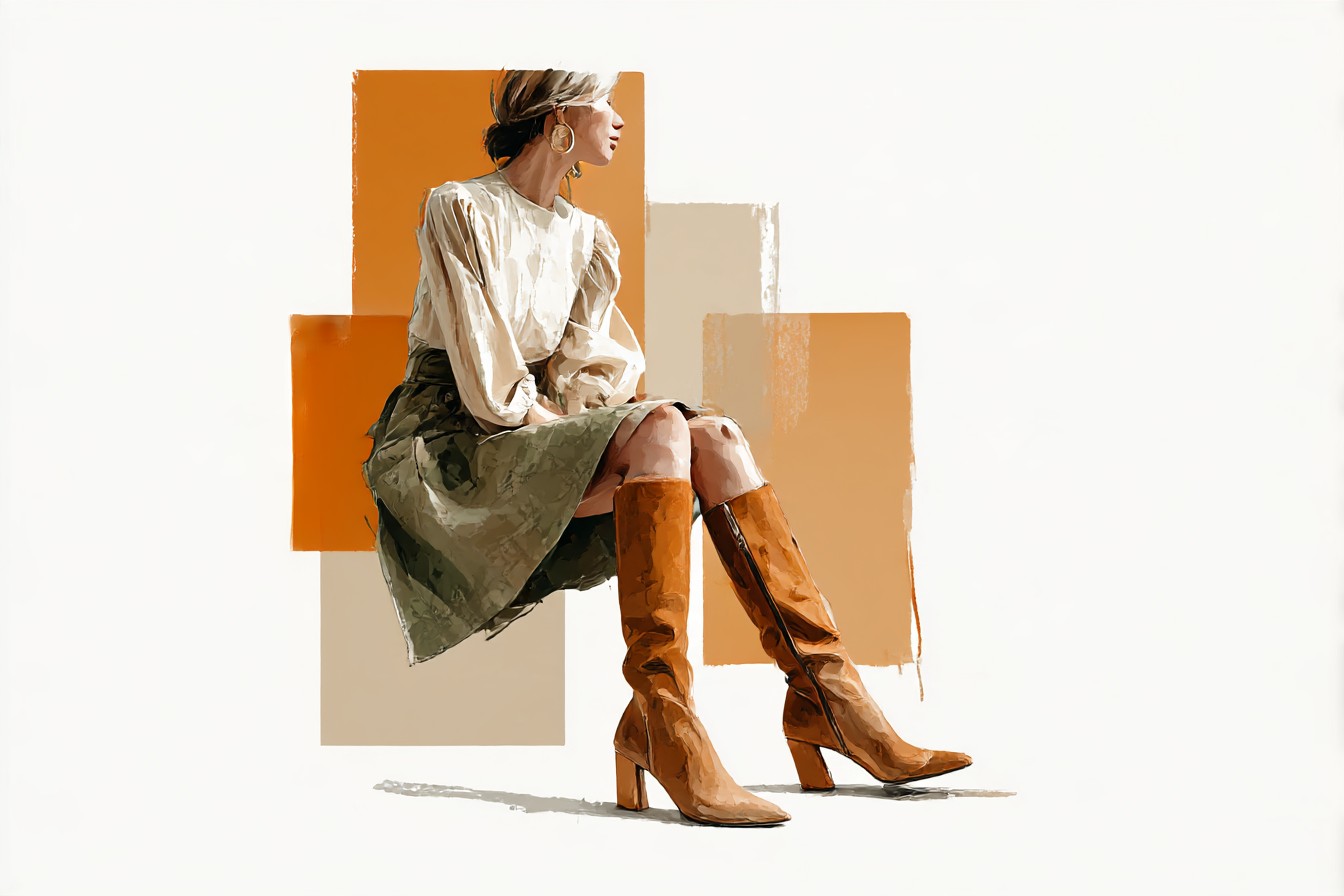
The reputation on brown knee high boots is that they’re the safe choice. The boot you buy because you couldn’t decide, the fallback for when the black pair is at the cobbler, something your aunt would wear to a school pickup and call it a day. I believed that for years. I owned exactly one pair, a chestnut faux leather thing from a mall store in 2016, and I wore them exactly the way that reputation suggests, jeans tucked in, cream sweater, done, boring, forgettable, the boot equivalent of beige wall paint.
What changed my mind was a listing I almost missed on a resale app at eleven forty at night, a pair of oxblood leaning brown Chloe boots, the kind of brown that has red under it depending on the light, hardware that had actual weight to it, not the tinny stuff. I checked the stitching count on the sole before I even looked at the price, which tells you everything about how I operate, and by the time I scrolled down to the number my hands were already shaking a little.

Three hundred and forty dollars for boots that retailed somewhere north of eleven hundred. I bought them in the time it takes to read this sentence, no second guessing, because I have learned the hard way that a good brown boot listing does not sit there being kind to you, it gets sniped, and I have lost more of those races than I have won.
What those boots taught me, once the adrenaline wore off, is that brown knee high boots are not one item. They are a wardrobe of tones and finishes and heel heights, and depending on which one you reach for, the same basic silhouette can look like you’re running errands or like you actually put thought into getting dressed today. A flat brown boot with worn in leather does something completely different from a sleek block heel version, which does something completely different again from a boot with a slight sheen to it under restaurant lighting. I did not understand any of this in 2016. I understand it now because I have spent eighteen months buying, returning, reselling, and occasionally losing bidding wars over brown boots specifically, and I have opinions about every single category of them.
So here is what I actually reach for, section by section, daytime through dressed up, and why the “boring commuter boot” reputation was never really about the boots, it was about the fact that most people, myself included, were only ever wearing one version of them.
[Brown Knee High Boots]
The Flat Riding Boot, for Every Day That Isn’t Trying to Prove Anything
This is the boot that started the whole bad reputation, and honestly it deserves some of the blame, because a cheap flat riding boot in a flat, matte brown can look like a costume piece if the leather has no texture to it at all. Mine is a pair of Frye boots I found secondhand for sixty dollars, which is such a stupid price for actual leather Frye boots that I checked the listing four separate times looking for a catch. There wasn’t one. The seller just didn’t know what she had, or didn’t care, and I am not going to pretend I felt bad about that.
What makes this boot work for daytime is the same thing that makes it look cheap when it’s done wrong, the leather itself. Mine has a slight pull up finish, meaning the color shifts a shade lighter when it creases at the ankle, and that variation is doing all the work. Worn with straight leg jeans tucked in loosely, not stuffed, an oversized flannel, hair not brushed properly because it’s Tuesday and nobody’s watching, it reads like something you’ve had forever, which at this point I actually have.
The mistake I made for years was pairing flat brown riding boots with anything too polished. A structured coat, a silk scarf, and suddenly the whole look feels like it’s arguing with itself, dressy jacket, lazy boot, nobody wins. These want denim, want a canvas tote, want to look like you walked somewhere instead of being dropped off. That’s the whole job of this category, and once I stopped trying to make it do more than that, I actually started wearing it three or four times a week.
[Casual Flat Riding Boots]
The Block Heel Boot, Which Is Doing More Work at the Office Than You’d Think
I resisted block heel knee high boots for a long time because I associated a two and a half inch stacked heel with looking like I was trying too hard for a Tuesday meeting. Then I actually wore a pair through a ten hour workday, standing meetings included, and I understood why every woman I know who works in an office owns at least one pair in exactly this category.
Mine are a warm cognac brown, almost the color of a well used leather couch, from a brand called Marc Fisher that I found through a resale search at, and I will die defending this theory, around nine on a Sunday morning, which is apparently when a certain kind of overwhelmed working woman clears out her closet before the week starts. The heel is stable enough that I can walk fast for a train without wobbling, which I cannot say about literally any stiletto boot I’ve ever owned, RIP to the ankle I nearly took out in 2021.
What this boot does for a work outfit is give you the polish of a heel with none of the performance. A midi skirt in charcoal or navy, a fitted turtleneck, the boots doing the entire job of looking finished without you having to think about a blazer. Or trousers, straight cut, boot underneath rather than boot over, which is a detail people notice more than you’d expect, a coworker actually asked me once if my trousers were tailored specifically for the boots. They were not. I just got lucky with the proportions that day.
The color is doing something specific here too. A true cognac reads warmer and slightly more forgiving under office fluorescent light than a black boot does, which sounds like a small thing until you’re the only person in a beige conference room not looking washed out.
[Block Heel Work Boots]
You Might Also Like

The Sleek Leather Boot That Actually Earns Its Place at Dinner
This is the category the Chloe boots belong to, and it’s the one I was the most wrong about for the longest time, because I genuinely believed brown couldn’t do evening the way black could. I held that opinion stubbornly for years, based on exactly one bad experience at a rooftop birthday dinner where I wore mushroom brown boots with a black dress and looked, according to a photo I have since deleted, like I got dressed in two different rooms.
The fix wasn’t switching back to black, it was matching the undertone properly. Those oxblood leaning boots have warmth in them, almost a burgundy cast in low light, and they work with anything that has warmth somewhere else in the outfit, a rust slip dress, a chocolate brown coat, even black if there’s gold jewelry doing the bridging work. What I learned, slowly, expensively, is that a sleek brown boot with almost no visible seaming reads as dressed up specifically because it looks minimal. No stitching detail fighting for attention, no chunky sole distracting from the line of the leg, just a long, clean column of leather that makes a simple dress look like you put in more effort than a dress and boots actually requires.
I wore them again three weeks after that first disaster, this time with a deep green silk dress and the same gold hoops I always default to, and got asked by someone at the bar where the boots were from, which has literally never happened to me in a decade of getting dressed for dinner. I told her the truth, resold designer, hunted at eleven at night, and she looked at me like I’d revealed a secret she wasn’t sure she wanted.
[Sleek Evening Boots]
Suede, Which I Avoided for a Decade Over One Ruined Pair
I have to be honest about where I started with suede, because it’s embarrassing. In 2014 I wore a pair of light brown suede knee high boots in the rain, no protectant, no umbrella, walked four blocks in a downpour like an idiot, and by the time I got inside they had watermarks so bad they looked tie dyed. I threw them out. I did not buy suede again for roughly ten years, which is a genuinely long grudge to hold against a fabric that did nothing wrong except get wet because I didn’t take care of it.
What brought me back was a pair of dark chocolate suede boots that showed up in a resale search with a description that specifically noted “protectant applied, worn twice,” which is the kind of detail that gets my attention faster than almost anything else in a listing. I checked, I bought, I finally spent nine dollars on a can of suede protectant like a functioning adult, and I have worn them through an entire fall without incident.
Suede does something a smooth leather boot can’t, it flattens the shine and makes the whole boot read softer, almost matte, which is why it pairs so well with textures that would otherwise clash, chunky knit dresses, corduroy, a wool skirt that has its own visible weave. It’s a daytime to early evening boot more than a strict office boot, in my experience, because that softness reads a little too casual under bright fluorescent light, but for a Saturday dinner or a walk through a farmers market it’s doing something a stiff leather boot just can’t.
[Suede Knee High Boots]
Wide Calf Brown Boots, and the Fit Fight Nobody Warns You About
I have to include this because I spent more money learning this lesson than any other one on this list. Standard knee high boots are cut for a specific calf width, and if you’re outside that range, which I am, every single “true to size” review on the internet is lying to you personally.
I found a pair of wide calf brown leather boots on a resale app on a Thursday afternoon, refreshed the listing four times in a row like that would somehow change the calf measurement, it did not, but I bought them anyway because the listing specified the shaft circumference in actual inches, which almost nobody does, and it matched. That specificity is the entire reason I trusted the purchase enough to skip trying them on first.

The difference a proper wide calf cut makes is not subtle. My previous “regular” boots left a visible line across my calf by hour three, an actual indentation, which is not a good look under a dress with any length to it. The wide calf pair sits flat against the leg the whole day, which means they work under everything, skinny jeans, midi skirts, even tucked under wide leg trousers where the boot barely peeks out but still needs to lie smooth to look intentional rather than accidental.
If there’s one category on this list I’d tell someone to research properly before buying secondhand, it’s this one, because a wide calf boot that doesn’t actually fit is a worse waste of money than almost anything else in a closet.
[Wide Calf Brown Boots]
Final Thoughts
I think the reputation brown knee high boots carry, the safe, boring, fallback label, comes from people only ever owning one version of them, the way I did for a decade with that one chestnut pair from the mall. Once you split the category up, flat and casual, block heeled and steady enough for a real workday, sleek enough for dinner, soft in suede, cut properly for an actual calf, it stops being one boring boot and starts being five completely different tools, all doing different jobs, all still just brown boots.
I don’t think I’ll ever stop hunting for the next one. That’s not really about the boots at some point, if I’m honest with myself, it’s about the chase, the listing at eleven at night, the stitching check before the price check, the small win of getting there before someone faster does. But the boots themselves have earned their spot too, every single pair I’ve mentioned here still gets worn, none of them are sitting in a box waiting to be resold, which for me is the actual test of whether something was worth the hunt at all.


[…] will. I lost one of the friction kind at a wedding in October, spent forty minutes on my hands and knees under a table in a dress that was not built for hands and knees, and found it eventually inside my own shoe, which is […]