
The moment always arrives at the coat rack, not before. You’re standing in the front hallway at 8:10, client call at 9, dinner with people from business school at 7, and you own exactly one trench because you decided years ago that buying a second felt excessive. You have thirty seconds to decide if it’s doing double duty today or if you’re about to look like you got dressed for the wrong event and never noticed.
I used to think this was a wardrobe problem. It’s actually a category problem, and nobody tells you that when you’re standing in the store admitting to yourself that the coat looks incredible on the hanger and you have no plan for it beyond that.
The Formality Comes From What’s Under It, Not the Coat Itself
Here’s the thing I got wrong for a solid two years: I treated the trench like it had a fixed formality rating, the way a blazer does, or a hoodie does. It doesn’t.

A trench is closer to a frame than a piece of art, and the piece of art underneath is doing almost all the actual work. Belt it over a sheath dress and low pumps and it reads as the last, sharpest layer of a formal outfit, the thing you take off in the elevator and hang on the back of a conference room chair without anyone blinking. Throw it over jeans and sneakers and it reads as a person who owns a nice coat and is running errands, which is a completely fine thing to be, just not the same person.
I found this out properly on a Tuesday when I wore mine over a blazer and trousers to a client meeting downtown, then kept it on for a walk to get coffee after, over the exact same outfit, and got two entirely different reactions within ninety minutes. In the meeting nobody registered the coat at all, it just disappeared into the formality of everything else, which is honestly the best compliment a coat can get. On the coffee walk a woman held the door and said “that coat is doing a lot of work today,” which I took as a compliment but also as proof that the coat reads differently depending on what room it’s standing in.
The reason this happens, if I’m being honest about the mechanics for one second and then dropping it, is that the trench was originally a utility garment, built to go over uniforms, and it’s kept that structural ambiguity ever since. It’s tailored enough to sit next to formal clothes without embarrassing them, and loose enough to sit over casual clothes without looking like you’re trying too hard. That’s not a design flaw. That’s the entire point of the coat, and treating it like it needs to pick a lane is missing why people have kept buying it for a hundred years.
You Might Also Like

So the question “is a trench coat formal or casual” is the wrong question, structurally. It’s not a garment with an answer. It’s a garment with a dependency, and pretending otherwise is how you end up over a boardroom outfit wondering why the coat suddenly feels like a costume.
The Fabric and the Belt Decide More Than People Want to Admit
Assuming you’ve got the outfit underneath sorted, the coat itself still has opinions, and most people ignore them. A stiff, structured cotton gabardine trench in a classic khaki, belted properly at the waist, is doing something completely different from a soft, drapey trench in navy or black with the belt just tied loose or left hanging. The first one has posture. It holds its shape sitting in a chair, it photographs cleanly on a video call, and it reads as considered even before anyone clocks what’s underneath it. The second one is relaxed by design, the kind of coat that looks better slightly rumpled, and it’s never going to read as boardroom no matter what you put beneath it, because the coat itself has already told everyone it’s off duty.
I own both, which took me an embarrassingly long argument with myself to justify, something about “occasion coverage” that I presented to myself with total seriousness and then immediately felt ridiculous saying out loud. The stiffer one goes to client meetings, goes over blazers, gets belted properly every single time because an unbelted structured trench just looks like you gave up halfway through getting dressed. The soft one goes over sweaters on weekends, gets thrown on over whatever, never gets the belt cinched because cinching it defeats the entire relaxed point of owning it. They cost about the same. They do completely different jobs, and if I only owned one I’d have to pick a lane in my actual life before I picked a coat, which is a strange amount of self awareness to require from outerwear.
The belt is the detail nobody talks about enough.
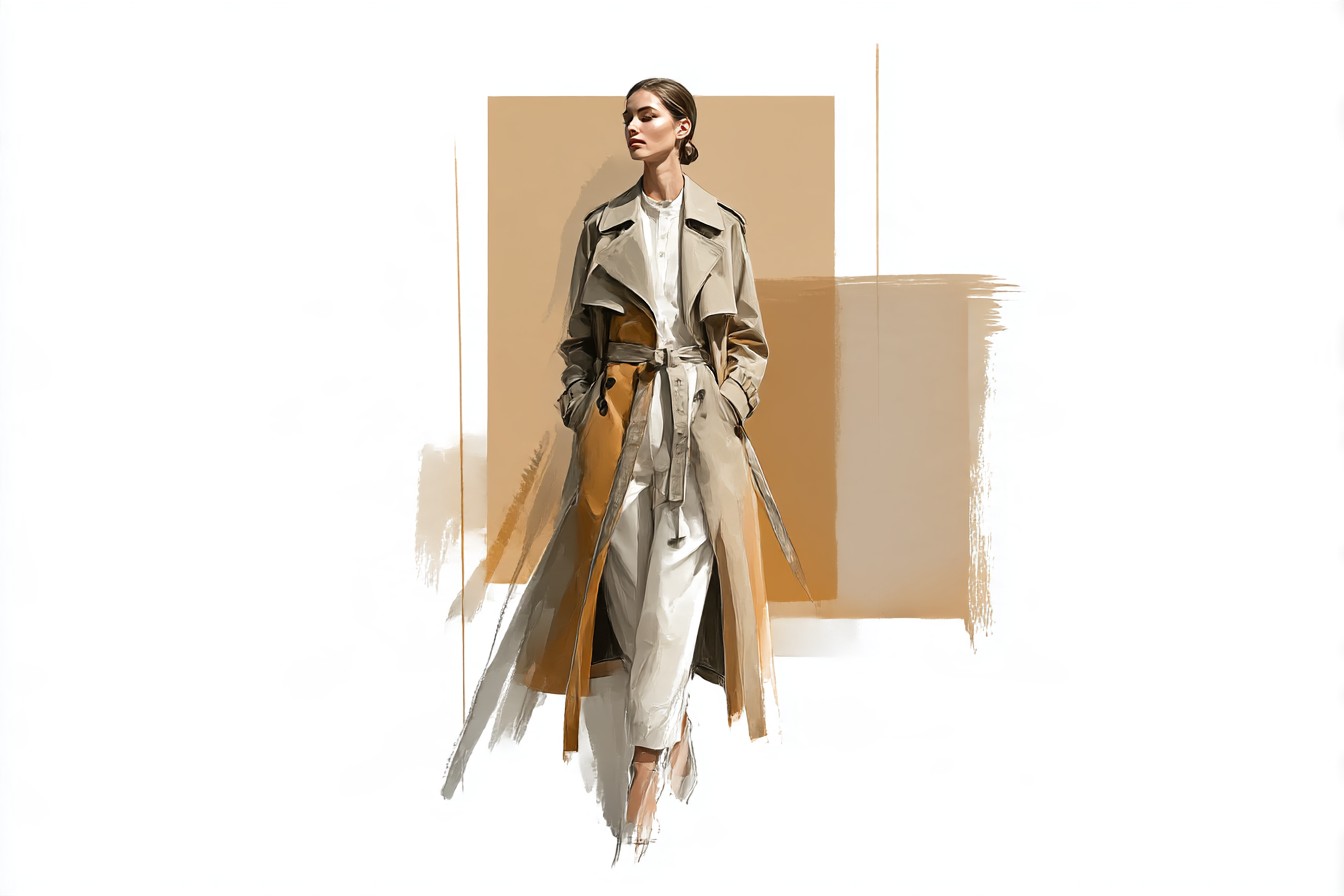
A trench belted tight and knotted at the front reads deliberate, reads like you made a decision about your silhouette. Left open and hanging loose it reads casual regardless of what fabric it’s made from, it’s basically the coat equivalent of an untucked shirt, comfortable, unbothered, not trying to make a point. I’ve watched the exact same coat go from “put together for the office” to “just got back from the farmers market” purely on whether the belt got tied, and it’s a genuinely small adjustment for how much weight it carries.
So no, the trench doesn’t sit in an awkward spot because it’s confused about what it is. It sits in an awkward spot because it refuses to make the decision for you, and most coats just don’t do that. A blazer tells you what it’s for the second you put it on. A trench hands the decision back and waits to see what you do with it, which is either the most useful thing a coat can do or mildly infuriating depending on how much patience you have for getting dressed before 9am. I’ve made my peace with it being the former, mostly because the alternative is admitting I’ve spent this much thought on a coat, and some things are better left unexamined before coffee.


